

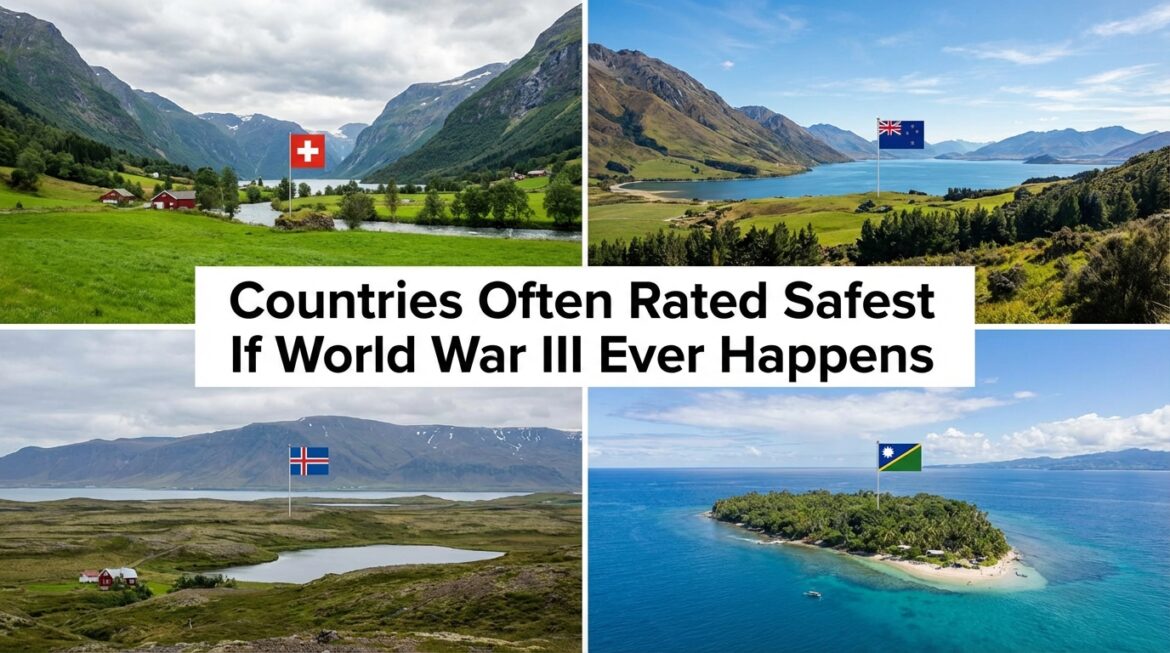
Whenever global tensions spike, travel and expat forums fill with the same nervous question: “If World War III really started, where could you actually feel safe?”
No place can promise total safety, but peace researchers and media reports keep circling back to a small set of countries that tick three big boxes: distance from major conflict zones, political neutrality, and strong internal stability.
Let’s look at five destinations that appear again and again – and what they’re really like if you’re thinking long‑term travel, slow living, or a “Plan B” base.
1. New Zealand – The world’s “end‑of‑the‑map” refuge
New Zealand sits deep in the South Pacific, far from traditional military flashpoints in Europe, the Middle East and North America.
It consistently ranks among the most peaceful countries on global indexes, thanks to low crime, stable democratic institutions and a foreign policy that generally avoids aggressive alliances.
- Day to day, that isolation feels like space to breathe.
- You get compact, chilled‑out cities, coastal roads that are almost too quiet, and a food system that still relies heavily on local farms and fisheries.
- If you like the idea of safety mixed with mountains, beaches and a strong outdoor culture, New Zealand is usually the first name on the list.
2. Iceland – Tiny, peaceful and powered by nature
Iceland has spent years at or near the very top of global peace rankings, with minimal violent crime and no standing army.
Its position in the North Atlantic keeps it physically removed from land‑based conflicts, while its politics lean heavily toward cooperation and diplomacy.
- What really sets Iceland apart is how self‑reliant it is in energy.
- Almost all of its electricity and heating come from geothermal and hydropower, which means the country is less dependent on imported fuel if global trade turns messy.
- For visitors and long‑stayers, that translates into warm homes, clean air, a tight‑knit society and a culture that values arts and everyday comfort over drama.
3. Switzerland – Neutral, organised and quietly prepared
Switzerland has built its identity around neutrality and has stayed out of major wars for centuries.
It hosts key international organisations and prefers cautious diplomacy over loud geopolitical posturing.
- Behind the postcard scenery, Switzerland is famously methodical about preparation.
- Civil defence systems, robust infrastructure and meticulous emergency planning are baked into how the country is run.
- If you’re looking for a place where institutions are strong, systems actually work, and people trust them, Switzerland scores very highly.
4. Bhutan – A calm Himalayan buffer
Bhutan sits deep in the Himalayas, with dramatic mountain ranges acting as natural walls between it and the rest of the region.
It follows a careful, independent foreign policy and has long limited tourism to protect its culture and environment.
- Instead of chasing raw economic growth, Bhutan measures “Gross National Happiness,” focusing on community, nature and mental well‑being.
- That mindset keeps it somewhat unplugged from the world’s loudest arguments and trend‑driven chaos.
- For anyone dreaming of a remote, slow‑life refuge, Bhutan offers monasteries in the clouds, forested valleys and a pace of life that seems almost deliberately unhurried.
5. Fiji – Remote islands far from the action
Fiji’s main “safety” asset is simple: it is very far away from most of the world.
This island nation sits in the South Pacific, distant from large population centres and major military infrastructure, and it rarely features in serious strategic war planning.
- On the ground, that distance feels like soft edges on everyday life.
- You wake up to warm seas, chatty markets and a culture that places a lot of weight on community and hospitality.
- If your version of a safe haven includes tropical weather, small communities and the option to disappear into island time, Fiji is hard to beat.
Even the “safest” countries can’t guarantee immunity in a real world war.
What they can offer is better odds: more distance from likely flashpoints, stronger peace records, and a lifestyle that’s less entangled with global tension.
The smart move is to treat these places not just as backup plans, but as meaningful travel experiences in their own right.
Whether you’re scouting a long‑stay base, planning a sabbatical, or just want a destination that feels calmer than the headlines, these five countries are a very good place to start.