

Rainfall is not spread evenly across the world, and surprisingly, some of the planet’s wettest countries are also among the most rewarding places to travel.
High rainfall shapes landscapes, ecosystems, food cultures, and even daily rhythms of life. But “rainiest” does not mean grey skies all day or non-stop downpours.
If you understand when and where the rain actually falls, many of these destinations become easier and often more enjoyable to explore.
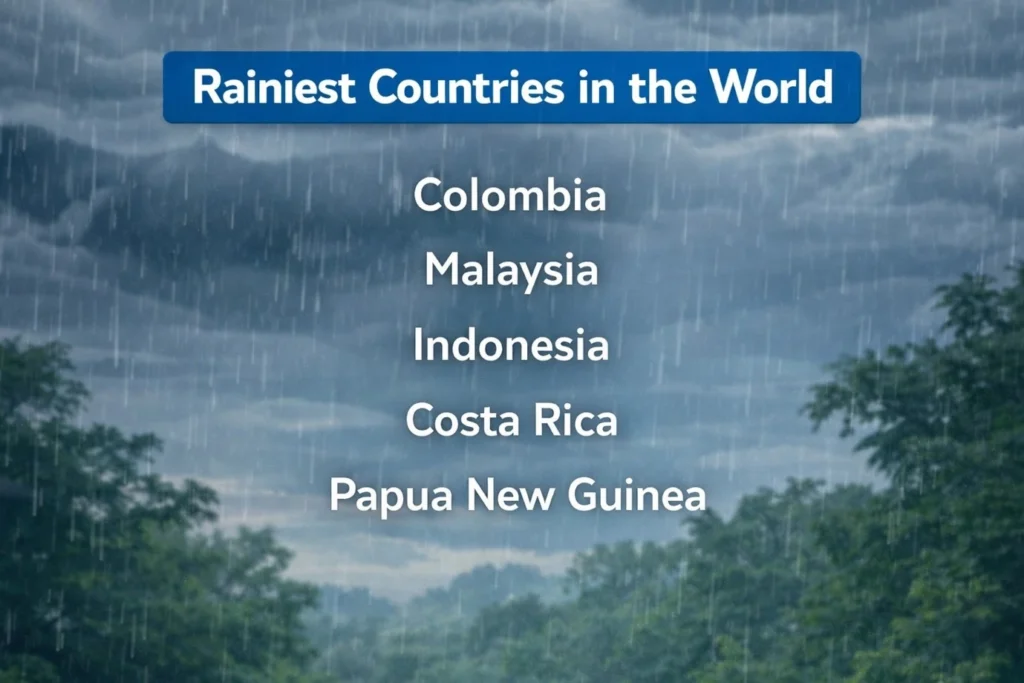
Recent FAO-based datasets place Colombia at the top, with roughly 3,240 mm of rain per year. Countries such as Malaysia, Indonesia, Costa Rica, and Papua New Guinea follow closely, each receiving around 2,700–3,100 mm annually far above the global average of about 1,170 mm.
Colombia: The Wettest on Paper, but Surprisingly Flexible for Travel
Colombia ranks as the world’s rainiest country on average, but rainfall inside the country varies dramatically.
Some areas along the Pacific coast and parts of the Andes can receive 6,000–7,000 mm of rain per year, while drier regions in the north and southwest get less than 500 mm.
Rather than four seasons, Colombia has wet and relatively drier periods.
For many popular destinations, December to March and July to August are generally drier, while April–May and October–November tend to be wetter—though this varies by region and altitude.
Even during wetter months, rain often arrives as showers, not continuous drizzle. In cities like Medellín or Bogotá, mornings can be clear, with rain appearing later in the day. Temperatures stay mild, landscapes turn lush, and travel between showers is usually easy.
Why rain improves the experience
- Colombia’s Amazon and Chocó regions are among the most biodiverse places on Earth.
- Regular rainfall supports coffee farms and misty landscapes ideal for hiking and photography.
Practical travel insight
- Drier periods: December–March and July–August work well for classic itineraries.
- Less rainy regions: Parts of the Caribbean coast and northern interior.
- When rain helps: Fewer crowds, greener landscapes, and stronger river systems.
Who Colombia suits best: slow travellers, digital nomads, and nature lovers who can adapt daily plans around showers.
Because rainfall varies so much by season and region, flight prices can change significantly depending on when you travel, making it useful to compare routes and dates before locking plans.
Malaysia: Monsoons, Not Endless Rain
Malaysia’s annual rainfall—around 3,000 mm—places it among the world’s wettest countries, but rain here follows predictable monsoon patterns, not random daily drizzle.
During the southwest monsoon (April/May–October), places like Penang, Kuala Lumpur, Selangor, Melaka and Johor Bahru on the west coast get more frequent showers, often as short, heavy downpours.
During the northeast monsoon (November–March), cities on the east such as Kota Bharu, Kuala Terengganu, Kuantan, Kota Kinabalu and Kuching see heavier rain and rougher seas, which can disrupt beach and island plans.
Rain in Malaysia often comes in short, heavy bursts, especially in cities. Warm temperatures continue year-round, and outdoor plans are rarely ruined for entire days.
What rain gives Malaysia
- Dense rainforests and wildlife across Peninsular Malaysia and Borneo
- Spectacular waterfalls and rivers
- Agricultural richness, shaping the country’s diverse food culture
Best for: slow travellers, digital nomads, and rainforest explorers who understand how to move between regions.
Budget travellers and backpackers often find that staying flexible with accommodation helps when rain affects plans. In many rainy destinations, hostels offer short stays, social spaces, and easy changes without long commitments.
Indonesia: High Rainfall, Huge Regional Differences
Indonesia’s average rainfall is about 2,700 mm per year, but this hides massive variation across its thousands of islands.
What to expect
- Java and Bali: Clear dry season (May–September), rainy season (November–March)
- Sumatra and Borneo: Wetter for longer periods
- Eastern islands: Generally drier
Even during the rainy season, especially in Bali, rain often falls for a few hours, usually in the afternoon or at night.
Why rain enhances travel
- Rice terraces and waterfalls are at their best after rain
- Volcanic landscapes remain lush and dramatic
- Morning windows often stay dry for hikes and excursions
Best for: travellers who plan mornings actively and accept flexible afternoons.
Costa Rica: Extreme Rainfall, Extreme Variety
Costa Rica averages close to 3,000 mm of rain annually, but the difference between regions is striking.
- Pacific coast: Clear dry season from December to April
- Caribbean side: Rain year-round, with small dips in certain months
- Mountains: Create strong rain-shadow effects
Why rain is central to Costa Rica’s appeal
Rain sustains:
- World-class rainforests and wildlife
- Powerful waterfalls and rafting rivers
- A strong eco-tourism economy
Best for: wildlife lovers and travellers willing to shift between coasts.
Papua New Guinea: Extremely Wet, Highly Niche
Papua New Guinea receives some of the highest rainfall on Earth, with certain regions exceeding 7,000 mm annually. Rainfall supports extraordinary biodiversity but also brings logistical challenges.
This destination suits experienced travellers, researchers, and expedition-style visitors, rather than casual tourists.
Why Rain-Rich Countries Reward Thoughtful Travellers
Across these countries, high rainfall is not a warning sign, it’s a signal of abundant water, fertile ecosystems, and seasonal rhythms. For long-stay travellers, bloggers, and digital nomads, understanding rainfall patterns allows you to:
Travelling in rainy seasons can actually be a smart strategy. You often avoid the biggest crowds, see landscapes at their absolute greenest and most alive, and still enjoy clear slots in the day by planning around predictable weather windows. The world’s rainiest countries are not places to avoid. They are places to understand better. And for travellers who do, they often become the most memorable.